Currently Empty: ₹0.00
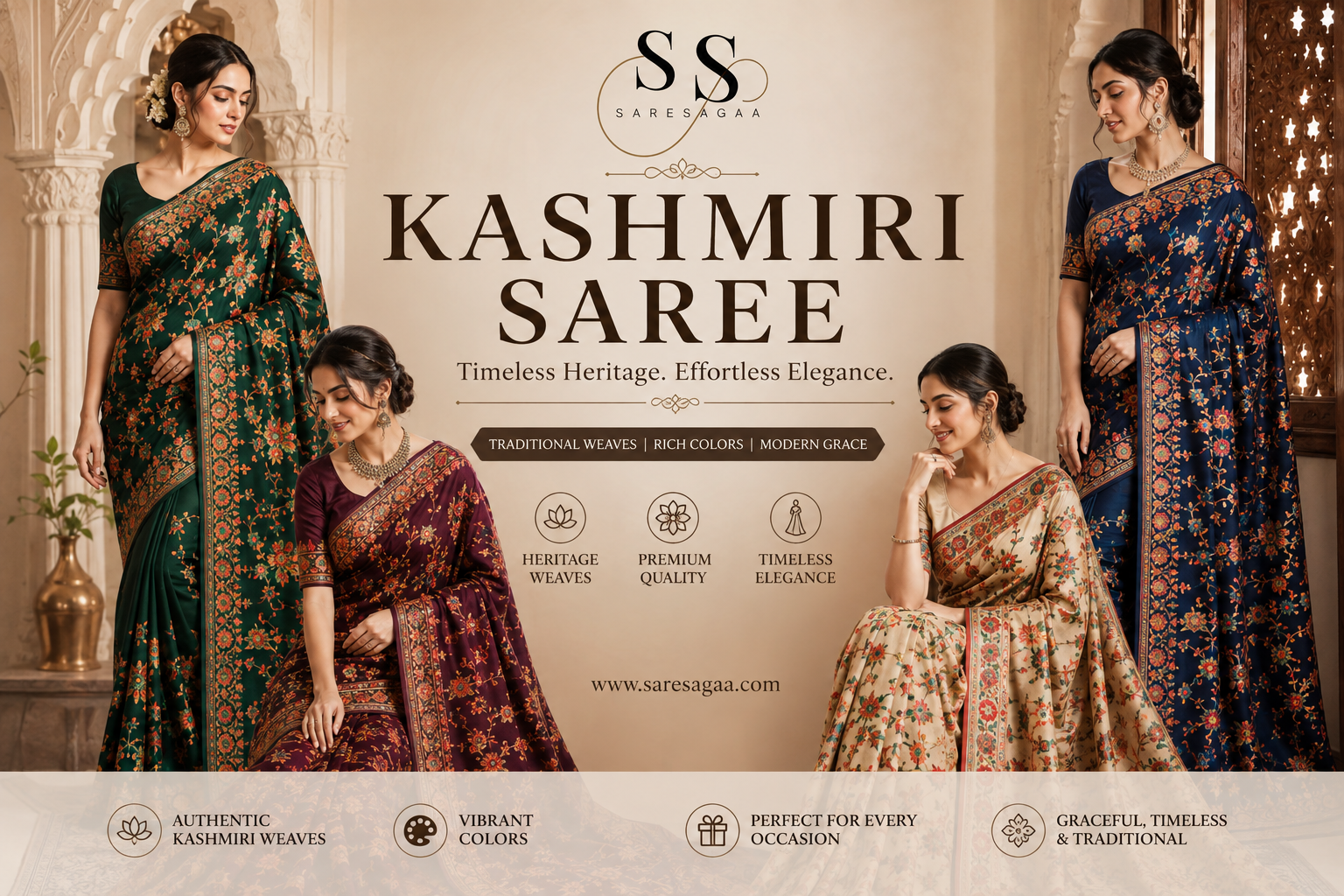
My aunt has a Kashmiri saree that’s older than me. Still gets compliments every single time she wears it. That’s the thing about these sarees — they don’t really go out of style, they just quietly get better with age.
If you’re planning to buy one, or you already own one and don’t know how to style it, this should help.
What Makes a Kashmiri Saree Different
Here’s the honest difference. Most sarees are made to look good. Kashmiri sarees are made to look good AND keep you warm. Kashmir stays cold for most of the year, so the fabric — pashmina, wool, tussar, sometimes georgette — is naturally heavier than what you’d find in, say, a South Indian or Bengal saree.
But fabric isn’t even the main attraction. It’s the embroidery. That’s what people are really paying for.
- Sozni work – super fine needle work, one thread at a time, painfully detailed
- Aari work – done with a hook needle, gives a raised, textured feel you can actually touch
- Tilla work – metallic gold or silver thread, looks rich and a bit royal
- Kashida embroidery – flowers, birds, chinar leaves, basically nature stitched onto fabric
A single piece can take a month, sometimes longer. So when you see the price tag on an original one and think “that’s a lot for a saree” — it’s not really about the fabric. You’re paying for someone’s weeks of handwork.
Types of Kashmiri Sarees You Should Know About
Pashmina Saree
Soft, light, warm — the works. Usually has tilla or sozni embroidery running along the border and pallu. If you’re attending a winter wedding and don’t want to freeze in a regular silk saree, Pashmina Saree is your answer.
Kani Saree
Made using little wooden sticks called “kani” instead of the usual shuttle. Sounds simple, but it’s actually one of the slowest weaving techniques out there. The pattern builds thread by thread, so the whole saree ends up with paisley or floral motifs woven throughout, not just stuck on the border like an afterthought.
Tilla Embroidery Saree
Base fabric is usually silk, georgette, or crepe, and the gold or silver thread work is the star of the show. Put this under evening lights and it practically glows. Great pick for receptions.
Sozni Saree
This one’s delicate. Almost feels like someone painted with a needle instead of a brush. Because the work is so fine, it takes the longest to finish — and yes, it costs more too.
Kashida Saree
All about nature. Flowers, birds, vines, chinar leaves, done in bright colors. Depending on the base fabric, this works for both daytime functions and evening ones.
Where Can You Actually Wear a Kashmiri Saree
You don’t need a huge occasion. Honestly, people overthink this part.
- Weddings – winter weddings especially, also sangeets and receptions
- Festivals – Diwali, Lohri, any winter festival where you want to look festive and stay warm
- Office events – a subtle sozni or kani piece looks classy without screaming for attention
- Family functions – these photograph really well, so good for get-togethers where pictures happen
- Pooja and religious functions – the colors and embroidery fit right into traditional settings
Basically wherever you’d normally reach for a Banarasi, you can swap in a Kashmiri saree instead. Bonus — you won’t be shivering through the event.
How to Style It Without Overdoing Things
The drape is only half of it. Most people mess up the styling part.
Keep the Blouse Simple
The saree is already busy with embroidery. Don’t add more noise. Plain silk or velvet blouse, matching or contrasting — pick one. A heavily worked blouse paired with a heavily worked saree just ends up looking like too much happening at once.
Go Easy on Jewellery
One statement piece is enough. Don’t load up.
- Tilla work saree → gold jhumkas, simple necklace
- Sozni or kani saree → oxidised silver or Kashmiri jadau pieces
- Skip the heavy neckpiece if your pallu is already dense with work
Hair and Makeup
Low bun or a side braid, both work. Keep makeup soft — warm tones, maybe a bold lip if you want that one pop of color. The saree’s already doing most of the talking, let it.
About Layering
Since a lot of these sarees are wool or pashmina, you often don’t need an extra shawl even in the cold. If it’s really biting outside, a plain pashmina stole in a neutral shade works without hiding the embroidery underneath.
Draping
Regular Nivi drape does the job for most Kashmiri sarees. If the pallu has heavy tilla or kani work on it, pin it down properly so it stays visible instead of folding weirdly on your shoulder halfway through the evening.
Which One Suits Which Occasion
Quick cheat sheet, if you’re deciding in a hurry:
- Wedding reception → Tilla embroidery, silk base, gold jewellery
- Sangeet or mehendi → Kani saree in bright colors, bold earrings
- Office event → Sozni saree in a muted shade, minimal jewellery
- Winter festival → Pashmina saree, warm tones, keep it simple
- Family function → Kashida saree, floral motifs, soft makeup
A Few Things Before You Buy One
These aren’t cheap, so a little caution helps.
- Hand embroidery has small irregularities. Machine work looks too perfect and uniform — that’s usually the giveaway
- Ask what the base fabric actually is. Pure pashmina and silk cost more than blended fabric, and sellers don’t always volunteer this
- Buy from verified Kashmiri artisans or GI-tagged sellers if authenticity matters to you
- Don’t rush it. This isn’t a saree you wear once and forget — it’s the kind that ends up in a trunk, passed down, worn again by someone else years later
That’s really what makes a Kashmiri saree worth it. It’s not just an outfit for one evening. It’s the kind of thing that sticks around in a family, worn by different people at different weddings, decades apart.
